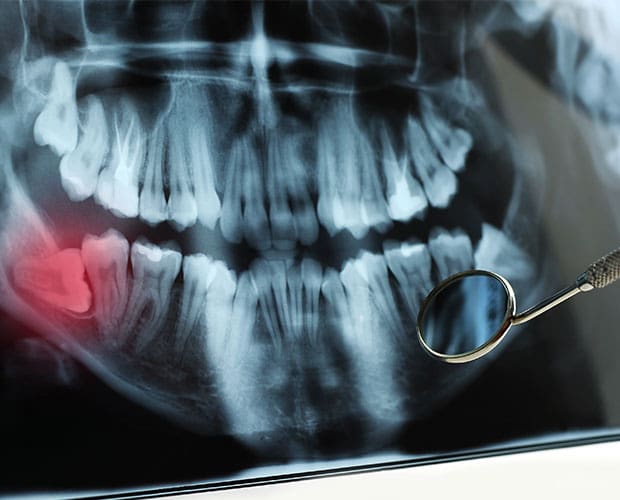
Wisdom teeth are the last teeth to arrive, and for most people, they cause more trouble than they’re worth. Whether your wisdom teeth are partially erupted, fully impacted, growing at an angle, or simply causing persistent pain and crowding, the team at Doncaster Dental provides safe, comfortable wisdom teeth extraction with a focus on your wellbeing before, during, and after the procedure.
We perform wisdom teeth extractions in-house chairside under local anaesthetic for straightforward cases, with referral to a hospital setting under general anaesthetic available for more complex surgical removals. In either case, our experienced dental team will assess your situation thoroughly, explain your options clearly, and ensure your recovery gets off to the best possible start.
We serve patients from Doncaster, Templestowe, Doncaster East, Balwyn North, Bulleen, Box Hill North, Blackburn North, and surrounding areas.
Experiencing wisdom tooth pain? Call us on (03) 9848 1322, we offer same-day emergency appointments for patients who call before 12pm.
Wisdom teeth, also called third molars, are the final set of teeth to emerge, typically appearing between the ages of 17 and 25. Most adults have four wisdom teeth, one in each corner of the mouth, though some people have fewer or none at all.
Unlike our ancestors who needed large molars for a coarser diet, modern humans generally have smaller jaws, meaning there’s simply not enough room for wisdom teeth to emerge properly. The result is that the vast majority of wisdom teeth either partially erupt, grow at an angle, or become fully trapped beneath the gum and bone, a condition known as impaction.
Not every wisdom tooth requires extraction. Teeth that have fully and correctly erupted, are properly aligned, and can be cleaned effectively may be left in place and monitored. However, the majority of wisdom teeth, due to the limited space available in the modern jaw, cause problems that make extraction the recommended course of action.
Common reasons wisdom teeth are extracted include:
Impaction
A fully or partially impacted wisdom tooth cannot emerge properly due to insufficient space or an obstructive angle. Impacted teeth can cause significant pain, pressure, and damage to adjacent teeth and bone.
Pericoronitis
When a wisdom tooth partially erupts, the overlying flap of gum tissue creates a trap for food debris and bacteria, leading to a localised infection called pericoronitis. Symptoms include swelling, pain, difficulty opening the mouth, and bad breath. Pericoronitis tends to recur until the tooth is removed.
Damage to adjacent teeth
Wisdom teeth growing at an angle can press against the roots of the second molars, causing damage, pain, and resorption of the neighbouring root structure.
Tooth decay
Wisdom teeth are located at the very back of the mouth where they are extremely difficult to clean properly. Tooth decay develops readily in these teeth and in the second molars adjacent to them, particularly in partially erupted wisdom teeth where the gum flap traps plaque.
Crowding and bite changes
Erupting wisdom teeth can exert pressure on the surrounding teeth, contributing to crowding and misalignment of the front teeth over time.
Cyst formation
Impacted wisdom teeth can develop fluid-filled cysts in the surrounding jaw bone, which, if left untreated, can enlarge and cause significant bone loss and damage to nearby teeth and nerves.
Preventive extraction
In some cases, wisdom teeth that are not yet causing symptoms are recommended for extraction to prevent future complications — particularly in younger patients where the roots are less developed and recovery is typically faster and more straightforward.
You should book an assessment at Doncaster Dental if you are experiencing:
Importantly, not all problematic wisdom teeth cause pain, particularly fully impacted teeth that remain below the gum line. Digital X-rays taken during your regular check-up and clean allow us to assess the position, angle, and development of your wisdom teeth and identify any concerns before symptoms develop.
Your dentist will conduct a thorough clinical examination and take digital X-rays, including OPG (full jaw) imaging where appropriate, to assess the precise position, angle, depth, and root development of your wisdom teeth. This gives us a complete picture of the extraction complexity and allows us to plan the safest and most efficient approach.
We’ll explain exactly what we find, discuss the recommended treatment, outline the procedure step by step, and answer any questions you have, before anything is scheduled. There’s no pressure and no obligation.
Chairside extraction under local anaesthetic — for wisdom teeth that have partially or fully erupted, or impacted teeth that are accessible in a straightforward position, extraction is performed in our practice under local anaesthetic. The area is completely numbed before any treatment begins, and you’ll feel pressure but no pain during the procedure. Sedation options are also available for anxious patients, ask our team for details.
Hospital extraction under general anaesthetic — for complex surgical cases involving deeply impacted wisdom teeth, teeth with unusual root formations, or patients who prefer to be fully asleep for the procedure, we provide referral to a hospital setting where the extraction is performed under general anaesthetic. Fasting is required before any procedure involving general anaesthetic, and you’ll need someone to drive you home afterwards.
Your dentist will recommend the most appropriate approach based on the complexity of your case and your personal preferences.
For a simple extraction, the dentist loosens the tooth using an instrument called an elevator before using extraction forceps to remove it from the socket. The procedure is typically completed in 20–40 minutes.
For a surgical extraction, a small incision is made in the gum to access the tooth. In some cases, the tooth or surrounding bone may need to be divided into sections to allow safe removal. The gum is then sutured closed with dissolvable stitches. Surgical extractions take longer depending on the complexity involved.
In both cases, gauze is placed over the socket after extraction and you’ll be asked to bite down firmly to assist clot formation. Detailed aftercare instructions are provided before you leave.
Recovery from wisdom teeth extraction varies depending on the complexity of the procedure. Here’s what to generally expect:
Days 1–2: Some bleeding, swelling, and jaw stiffness is normal and expected. Swelling typically peaks around 48 hours post-procedure. Stick to soft foods, avoid hot drinks, and rest as much as possible. Apply a cold compress to the outside of the face (20 minutes on, 20 minutes off) to reduce swelling.
Days 3–5: Swelling begins to subside and discomfort becomes more manageable. Most patients find over-the-counter pain relief such as ibuprofen sufficient for managing post-operative soreness.
Days 7–10: For surgical extractions, dissolvable stitches begin to dissolve. Most patients are back to a normal diet and daily activities by this stage.
Weeks 2–4: Full healing of the gum tissue completes over this period. Deeper bone healing continues over several months but causes no discomfort.
Following your extraction, carefully adhere to these aftercare guidelines to support healing and reduce the risk of complications:
Do:
Avoid:
If you experience severe or worsening pain after day two, a bad taste, or visible exposed bone in the socket, contact Doncaster Dental promptly on (03) 9848 1322, these may be signs of dry socket, which requires prompt treatment.
Accurate pre-operative assessment. We use digital X-rays and OPG imaging to assess every wisdom tooth thoroughly before treatment, ensuring we select the safest and most appropriate approach for your specific case. Learn more about our technology →
In-house and hospital options. We handle straightforward and moderate extractions in-house under local anaesthetic, and arrange hospital-based general anaesthetic procedures for complex surgical cases, so all your needs are managed by our team from assessment through to post-operative care.
Same-day emergency appointments. Wisdom tooth pain can be severe and sudden. If you call before 12pm, we’ll do our best to see you the same day. Call (03) 9848 1322) immediately if you’re in significant pain.
Experienced, gentle dentists. Our team, Dr Jamie Do, Dr Brendan Moore, and Kate Jolly, performs extractions with precision, patience, and a genuine focus on keeping you comfortable throughout.
Comprehensive dental care. Following extraction, we provide ongoing care to maintain the health of all remaining teeth, from routine check-ups and cleans to restorative treatments if any adjacent teeth have been affected.
Established since 1962. One of Doncaster’s trusted and long-serving dental practices, caring for families across the community for over 60 years.
Wisdom teeth are the third and final set of molars, typically emerging between the ages of 17 and 25. Most people’s jaws do not have enough space to accommodate them properly, which means they often grow at an angle, only partially erupt through the gum, or become trapped beneath the gum entirely — a condition known as impaction. This can lead to pain, swelling, infection, damage to neighbouring teeth, and misalignment of the bite.
Common signs that wisdom teeth may need to be extracted include persistent pain or aching at the back of the jaw, swollen or bleeding gums around the back teeth, difficulty opening your mouth, bad breath or an unpleasant taste near the back of the mouth, and pressure or crowding of neighbouring teeth. However, not all problematic wisdom teeth cause immediate symptoms. At Doncaster Dental, X-rays taken during a check-up allow the dentist to assess the position of your wisdom teeth and recommend extraction before complications develop.
An impacted wisdom tooth is one that cannot fully emerge through the gum because there is insufficient space in the jaw, or because it is growing at an angle that prevents normal eruption. Partially impacted wisdom teeth — where the tooth breaks through the gum only partially — are particularly prone to infection, as the flap of gum tissue surrounding them traps food and bacteria. Fully impacted wisdom teeth remain completely below the gumline and can damage the roots of adjacent teeth if left untreated.
The extraction procedure itself is not painful as it is performed under local anaesthetic, which completely numbs the tooth and surrounding area. For more complex cases, such as deeply impacted wisdom teeth, the procedure can be carried out under general anaesthetic in a hospital setting. After the anaesthetic wears off, some soreness, swelling, and jaw stiffness is normal for several days. This is typically managed well with over-the-counter pain relief such as ibuprofen and following the aftercare instructions provided by your dentist at Doncaster Dental.
The process begins with a consultation where your dentist assesses your wisdom teeth using advanced X-ray technology to determine the complexity of the extraction. Depending on the position and depth of the tooth, the extraction is performed chairside under local anaesthetic or in a hospital under general anaesthetic. The procedure typically takes one to two hours. Fasting is required before any procedure involving general anaesthetic. After extraction, detailed aftercare instructions are provided to support recovery.
Most patients feel well enough to return to normal daily activities within two to three days of a straightforward wisdom tooth extraction. Swelling and jaw stiffness typically peak around 48 hours after the procedure and gradually subside over the following few days. Full healing of the gum tissue generally takes two to four weeks. Recovery from more complex surgical extractions involving impacted teeth may take longer. Avoiding hard foods, smoking, and vigorous rinsing in the first 24 hours helps protect the healing socket and reduces the risk of complications.
Dry socket is a complication that can occur after a tooth extraction when the blood clot that forms in the socket becomes dislodged or dissolves before the wound has healed, leaving the underlying bone and nerves exposed. It is characterised by a sharp, throbbing pain that typically develops two to four days after extraction and may radiate to the ear or jaw. To reduce the risk of dry socket, avoid smoking, drinking through a straw, spitting forcefully, and vigorous rinsing for at least 24 hours after your extraction. If you suspect dry socket, contact Doncaster Dental on (03) 9848 1322 promptly.
Not necessarily. The decision depends on the position, development, and impact of each wisdom tooth individually. Some patients have all four removed in a single procedure for convenience, particularly when general anaesthetic is being used. In other cases, only the problematic teeth are extracted, while those that have erupted correctly and are causing no issues may be monitored and left in place. Your dentist at Doncaster Dental will assess each tooth individually and recommend the most appropriate plan for your situation.
Wisdom tooth extraction is generally covered under major dental with private health insurance extras policies in Australia, though the level of cover varies significantly between funds and plans. More complex surgical extractions may also attract a hospital benefit if the procedure is performed under general anaesthetic. Annual limits and waiting periods may apply. It is worth checking with your insurer before your procedure. Doncaster Dental can provide an itemised treatment plan to help you understand out-of-pocket costs and submit a claim.
Take advantage of our new patient special today. Call us on (03) 9848 1322 or book online!