A missing tooth is rarely just a cosmetic concern. Without a tooth root in position, the surrounding jawbone can begin to shrink over time, neighbouring teeth may drift out of alignment, the opposing tooth can over-erupt, and chewing efficiency can be affected — consequences that tend to become more significant the longer a gap is left unaddressed.
Of the options available for replacing missing teeth, dental implants are designed to replace both the visible tooth and the root beneath it. This is intended to provide a restoration that looks, feels, and functions similarly to a natural tooth, and is cared for in a comparable way. As with any treatment, implants have their own considerations and suitability requirements compared with bridges or dentures, and your dentist can help you weigh these up.
At Doncaster Dental, we provide dental implant treatment, from initial assessment and implant placement through to final crown delivery, provided by our dental team at 838 Doncaster Road.
We offer a dental implant consultation, including X-rays, at no charge for patients considering implant treatment. View our specials → or call (03) 9848 1322 to book.
We see patients from Doncaster, Templestowe, Doncaster East, Balwyn North, Bulleen, Box Hill North, Blackburn North, and surrounding suburbs.
Of all the options available for replacing missing teeth, dental implants are the only solution that replaces both the visible tooth and the root beneath it. The result is a restoration that looks, feels, functions, and is cared for exactly like a natural tooth, with none of the drawbacks of bridges or dentures.
At Doncaster Dental, we provide comprehensive dental implant treatment, from initial assessment and implant placement through to final crown delivery, managed by our experienced dental team at 838 Doncaster Road.
We offer a complimentary dental implant consultation including X-rays for patients considering implant treatment. View our specials → or call (03) 9848 1322 to book.
We serve patients from Doncaster, Templestowe, Doncaster East, Balwyn North, Bulleen, Box Hill North, Blackburn North, and surrounding suburbs.
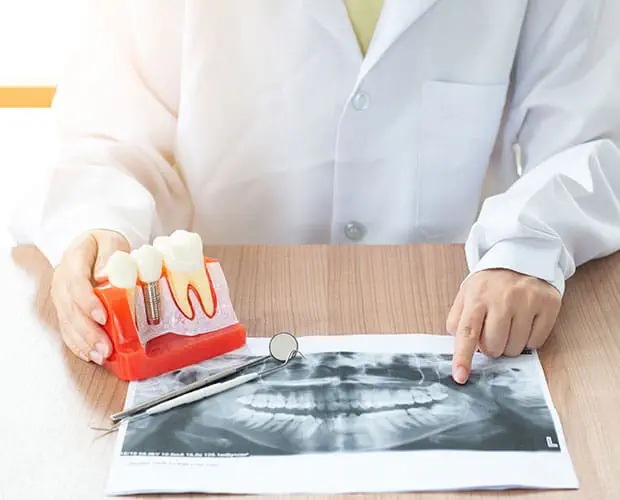
A dental implant is a three-part tooth replacement system:
1. The implant post — a small titanium screw that is surgically placed into the jawbone, where it acts as an artificial tooth root. Titanium is used because it is biocompatible and uniquely capable of fusing directly with living bone through a natural biological process called osseointegration.
2. The abutment — a small connector piece that attaches to the top of the implant post once integration is complete. It sits just at or slightly above the gum line and serves as the anchor point for the crown.
3. The crown — a custom-made ceramic restoration that attaches to the abutment and forms the visible portion of the replacement tooth. It is colour-matched, shaped, and sized to blend seamlessly with the surrounding natural teeth.
Together, these three components replicate the full structure of a natural tooth from root to crown, providing a result that is indistinguishable from the real thing in both appearance and function.
There are three main options for replacing a missing tooth: dental implants, dental bridges, and dentures. Each has its place, and your dentist will always discuss all options honestly. For patients who are suitable candidates, implants may offer a number of potential benefits:
Adjacent teeth are generally left untouched — a dental bridge typically requires reshaping the healthy teeth on either side of the gap to support the restoration. Implants are self-supporting, so adjacent teeth are usually not altered.
May help support jawbone health — one potential benefit of implants is that the titanium post can help stimulate the jawbone in a way similar to a natural tooth root, which may help reduce the bone loss that can occur after tooth loss. Bone loss over time can affect facial contours. This is an area where your dentist can advise on what’s relevant to your individual case.
Fixed in place — once osseointegration is complete, the implant is anchored in the jaw. Unlike dentures, there is nothing to remove or soak overnight, which may reduce the risk of movement while eating or speaking.
Supports chewing function — implants are designed to support chewing efficiency, with bite forces distributed through the implant post into the jawbone in a way similar to a natural tooth root. Individual results can vary.
Designed for the long term — the implant post is designed to be a long-term solution, though individual outcomes depend on factors like oral hygiene and bone health. The crown may need replacement over time, typically after a number of years depending on wear. Your dentist can discuss the long-term cost considerations compared with other options as part of your treatment plan.
Maintenance similar to natural teeth — implants are generally cared for through brushing, flossing, and regular check-ups and cleans, without the need for special cleaning tools or removal routines.
Limited impact on adjacent teeth — because bridges rely on adjacent teeth for support, this can increase wear and the risk of decay in those teeth over time. Implants generally don’t carry this same consideration.
Dental implants are a versatile solution for a range of tooth replacement scenarios:
Single tooth replacement — a single implant with a custom crown replaces one missing tooth without affecting adjacent teeth. This is the most common implant application.
Multiple tooth replacement — multiple individual implants can replace several missing teeth across the arch, each functioning independently without relying on any other tooth for support.
Implant-supported bridge — two implants can support a bridge of three or more teeth, providing a fixed solution for multiple adjacent missing teeth without the need for an implant for every tooth.
Implant-retained dentures — for patients who are missing all or most of their teeth, two or more implants can anchor a full denture securely in the jaw, eliminating the movement and discomfort of conventional removable dentures. The denture can still be removed for cleaning.
Full arch replacement (All-on-4 / All-on-6) — multiple implants placed strategically in the jaw can support a complete arch of fixed teeth, a permanent alternative to full dentures. Ask our team if this option may be relevant to your situation.
Here’s a short 10-second practice walkthrough video 😊
Most healthy adults with one or more missing teeth are potential candidates for dental implants. Key factors that influence suitability include:
Jawbone density and volume — a sufficient amount of healthy bone must be present to support the implant post. Patients who have experienced significant bone loss following tooth extraction may require bone grafting before implant placement. Our OPG X-ray imaging allows us to assess bone volume precisely at your consultation.
General health — implant placement is a minor surgical procedure and requires adequate healing capacity. Uncontrolled diabetes, certain medications (such as bisphosphonates used for osteoporosis), conditions that impair immune function, and a history of radiation therapy to the jaw can all affect suitability and outcomes.
Oral health — active gum disease or significant untreated tooth decay must be addressed before implant placement. A healthy oral environment gives implants the best possible foundation.
Smoking — smoking significantly impairs healing and increases the risk of implant failure. Non-smokers generally achieve better outcomes. Smokers can still receive implants but should be aware of the elevated risk and discuss this honestly with their dentist.
Age — implants are generally not placed until jawbone development is complete, which typically occurs in the late teens. There is no upper age limit for dental implants, suitability is determined by health, not age.
A comprehensive assessment at Doncaster Dental — including clinical examination, detailed digital X-rays and OPG imaging, and a full medical and dental history review, is required to determine your individual suitability. This consultation is complimentary at Doncaster Dental. Book now →
Your dentist conducts a thorough clinical examination, takes digital X-rays and OPG imaging to assess bone volume and density, reviews your medical and dental history, and discusses your goals and expectations. We’ll explain all relevant tooth replacement options, confirm whether implants are suitable for your situation, outline the treatment plan and timeline, and provide a full cost estimate before any treatment is scheduled. This consultation is complimentary and includes X-rays. View current specials →
If gum disease is present, it must be treated before implant placement to ensure a healthy environment for healing. Bone grafting may be recommended for patients with insufficient bone volume, this involves placing bone graft material in the deficient area to encourage new bone growth before the implant can be placed. Preparatory treatment adds to the overall timeline but is essential for long-term implant success.
The implant post is placed into the jawbone in a minor surgical procedure performed under local anaesthetic at Doncaster Dental. Your dentist makes a small incision in the gum to access the bone, precisely positions the titanium implant post, and closes the gum tissue over the implant with fine sutures. The procedure typically takes 30–60 minutes per implant.
After placement, some swelling, bruising, and mild soreness is normal for several days. This is well managed with prescribed or over-the-counter pain relief and typically resolves within a week. You’ll receive detailed aftercare instructions before you leave.
Over the following 3–6 months, the titanium implant post fuses with the surrounding jawbone through osseointegration, the biological process that gives implants their exceptional stability. During this period the implant is not visible or functional from the outside, and a temporary restoration or space maintainer is used to preserve aesthetics and function while healing occurs.
Following your dentist’s aftercare instructions carefully, particularly avoiding smoking and maintaining excellent oral hygiene, is critical to successful osseointegration.
Once osseointegration is confirmed via X-ray, a minor procedure is performed to expose the top of the implant and attach the abutment. In some cases, this can be done at the same time as implant placement. The abutment sits just at or slightly above the gum line, ready to receive the final crown.
A precise impression or digital scan of the abutment and surrounding teeth is taken and used to fabricate your custom ceramic crown. The crown is colour-matched and shaped to blend naturally with your existing teeth. Once ready, it is attached to the abutment, completing the implant restoration. Your dentist will check the fit and bite carefully and make any fine adjustments needed to ensure the crown feels completely natural.
One of the great advantages of dental implants is how straightforward they are to maintain:
Brush twice daily — use a soft-bristled toothbrush and fluoride toothpaste, cleaning around the implant crown at the gum line just as you would a natural tooth.
Floss daily — floss around the implant crown to remove plaque from the gum margin. Interdental brushes or a water flosser can also be effective for cleaning around implants.
Attend regular check-ups and cleans — professional cleaning and monitoring of the implant, crown, and surrounding bone and gum tissue is essential. Your dentist will assess the implant at each visit using digital X-rays to confirm continued bone stability.
Wear a nightguard if you grind your teeth — teeth grinding (bruxism) places excessive force on the implant crown and can significantly shorten its lifespan. A custom nightguard is strongly recommended for all implant patients who grind.
Avoid smoking — smoking impairs circulation and immune function, increasing the risk of peri-implantitis (infection around the implant) and implant failure, even years after successful placement.
Complimentary consultation including X-rays. We offer a no-obligation implant consultation that includes X-rays so you can get a clear picture of your suitability, the treatment plan, and costs before making any decisions. View our specials →
Comprehensive assessment with advanced imaging. We use digital X-rays and OPG imaging for precise evaluation of bone volume, density, and anatomy, essential for safe and accurate implant planning. Learn more about our technology →
CEREC crown technology. In suitable cases, our CEREC technology can be used to fabricate the implant crown in-house, reducing wait times and the number of appointments required.
Complete care under one roof. From initial consultation and preparatory treatment through to implant placement, healing, abutment placement, and final crown, all managed by our experienced team at 838 Doncaster Road. Referral to external specialists is not required for most cases.
Experienced dental team. Our dentists, Dr Jamie Do, Dr Brendan Moore, and Kate Jolly, bring extensive experience to implant assessment and placement, with a thorough, patient-focused approach at every stage.
Interest-free payment plans. Dental implants represent a significant investment. Interest-free payment plans are available to help spread costs over time. Speak with our reception team on (03) 9848 1322 to discuss options before your appointment.
Established since 1962. One of Doncaster’s most trusted and long-serving dental practices, providing high-quality restorative dental care to the local community for over 60 years.
A dental implant is a permanent tooth replacement solution consisting of three components: a titanium post that is surgically placed into the jawbone and acts as an artificial tooth root, an abutment that connects the post to the visible restoration, and a custom-made ceramic crown that sits on top and replicates the appearance and function of a natural tooth. Over a period of several months following placement, the titanium post fuses directly with the surrounding jawbone through a process called osseointegration — creating a stable, permanent foundation that functions like a natural tooth root. Dental implants are the only tooth replacement option that replicates the full structure of a natural tooth, from root to crown.
Dental implants are designed to be a permanent, lifelong solution. The titanium implant post, once fully integrated with the jawbone, can last a lifetime with proper oral hygiene and regular dental check-ups. The ceramic crown attached to the top of the implant is subject to the same wear as natural teeth and may need to be replaced after 15 to 25 years, depending on how well it is cared for and whether the patient grinds their teeth. Patients who grind their teeth are strongly advised to wear a custom nightguard to protect their implant crown from premature wear. With good home care and regular check-ups at Doncaster Dental, dental implants can comfortably outlast all other tooth replacement alternatives.
The implant placement procedure is performed under local anaesthetic, which numbs the area completely before any surgical work begins. Most patients report that the procedure is more comfortable than they anticipated — comparable in sensation to a tooth extraction. Some swelling, bruising, and mild soreness in the days following surgery is normal and expected as part of the healing process, and can be effectively managed with over-the-counter pain relief such as ibuprofen and cold compresses. Prescription pain relief may be provided for more complex cases. If pain worsens significantly after the first two to three days or is accompanied by swelling that is increasing rather than subsiding, contact Doncaster Dental on (03) 9848 1322 promptly.
The full dental implant process at Doncaster Dental from initial consultation to final crown placement typically takes between three and six months, though this varies depending on individual factors. After the implant post is placed, a healing period of three to six months is required for osseointegration — the process by which the titanium fuses with the jawbone — before the abutment and crown can be attached. Patients who require bone grafting prior to implant placement will need additional healing time before the implant itself can be placed, which can extend the overall timeline. Your dentist will provide a personalised treatment timeline during your consultation based on your specific situation.
Dental implants are suitable for most healthy adults with one or more missing teeth and sufficient jawbone density to support the implant post. Good general health and a commitment to oral hygiene are important factors for long-term implant success. Factors that may affect suitability include insufficient bone volume — which may be addressable with bone grafting — uncontrolled diabetes, certain medications such as bisphosphonates used for osteoporosis, heavy smoking, and some medical conditions that impair healing. Age is also a consideration — implants are generally not placed until jawbone development is complete, typically in the late teens. A comprehensive assessment at Doncaster Dental including X-rays and a full medical and dental history review is required to determine your individual suitability.
Osseointegration is the biological process by which the titanium implant post bonds directly with the surrounding jawbone cells, becoming a stable, integrated part of the bone structure. The term comes from the Latin “os” (bone) and “integrate” (to make whole). This process is what gives dental implants their exceptional stability and longevity — unlike dentures or bridges, an osseointegrated implant is anchored as firmly as a natural tooth root. Osseointegration typically takes between three and six months. During this period it is important to follow your dentist’s aftercare instructions carefully, avoid smoking, and maintain good oral hygiene to give the implant the best possible conditions for successful integration.
Both dental implants and bridges can replace a missing tooth with a fixed, non-removable restoration — but the way they achieve this is fundamentally different. A dental bridge anchors a false tooth between two crowns placed over the healthy teeth on either side of the gap, requiring those adjacent teeth to be permanently reshaped. A bridge does not replace the tooth root and does not prevent the jawbone beneath the gap from resorbing over time. A dental implant replaces the tooth root with a titanium post placed directly in the jawbone — no modification of adjacent teeth is required, and the implant actively stimulates the jawbone to prevent bone loss. Implants are generally the preferred long-term option where bone and health allow, while bridges remain a reliable alternative where implants are not suitable.
Dental implant failure is uncommon — success rates for implants placed in healthy patients with adequate bone are consistently above 95% over ten years. However, failure can occur in some cases. Early implant failure happens when osseointegration does not occur successfully, often due to infection, smoking, uncontrolled systemic conditions, or poor bone quality. Late implant failure can occur years after successful integration, typically due to peri-implantitis — a bacterial infection of the tissue surrounding the implant that is similar to gum disease. Warning signs of implant complications include pain or discomfort at the implant site that does not resolve, swelling or bleeding around the implant, visible movement or looseness of the implant, and gum recession around the implant. If you notice any of these signs, contact Doncaster Dental on (03) 9848 1322 promptly — early intervention gives the best chance of preserving the implant.
Dental implants are generally classified as major dental and may attract a partial benefit under higher-tier private health insurance extras policies in Australia. However, implant coverage is subject to significant variation between funds — annual limits, waiting periods of up to 12 months, and lifetime sub-limits on major dental prosthetics all apply and vary considerably. Many standard or mid-tier extras policies do not include meaningful implant cover. It is worth reviewing your policy carefully and contacting your insurer directly before beginning treatment to understand your specific entitlements and expected out-of-pocket costs. Doncaster Dental can provide a detailed itemised treatment plan to assist you in checking your cover and submitting any applicable health fund claims.
Take advantage of our new patient special today. Call us on (03) 9848 1322 or book online!